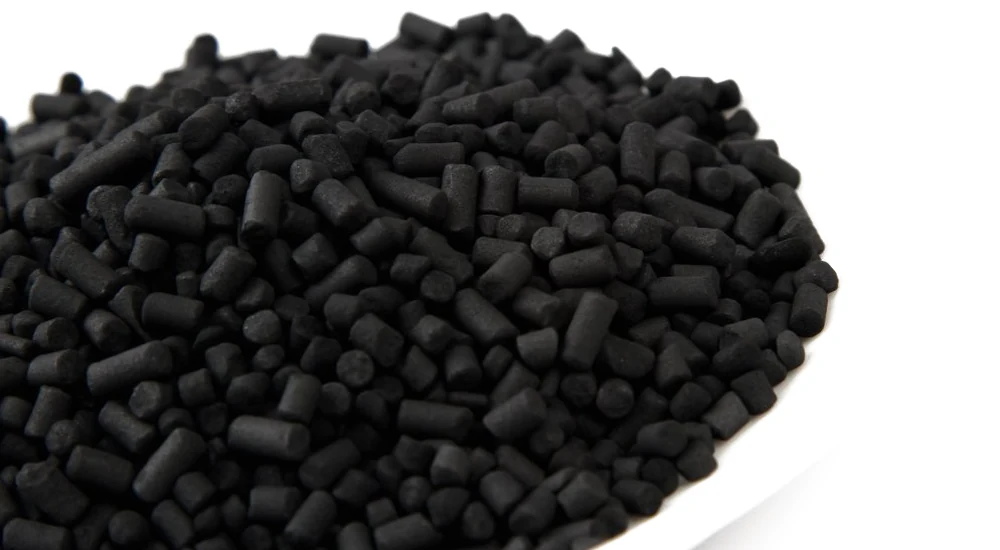
TLX desulfurisation activated coke is a columnar activated coke made by Qunli from coal by high-pressure forming, mainly for dry flue gas desulfurisation and denitration. High mechanical strength and adsorption capacity meet the demands of continuous tower operation and repeated regeneration in steel sintering and coking service.
Product features
The activated coke process differs from wet desulfurisation in using little water, producing no secondary solid waste such as gypsum, removing SO2, NOx and dioxins together, and yielding a by-product that can be turned into sulphuric acid. It demands very high mechanical strength: the coke bed repeatedly cycles through adsorption, heated regeneration and cooling, and weak coke keeps breaking up and is carried out with the gas, raising make-up rates and blocking downstream equipment. High-pressure forming exists precisely to keep the pellets intact through long-term thermal cycling.
Product specifications
| Project | Notes |
|---|---|
| Raw material | Coal |
| Manufacturing process | Coal blending - high-pressure forming - carbonisation - activation |
| Product form | Cylindrical activated coke |
| Standard specifications | Diameter 5 mm / 9 mm columnar |
| Suitable operating conditions | Dry desulfurisation for steel sintering, coking and coal-fired boiler flue gas |
| Testing performed | Test items and methods agreed to your operating conditions |
| Packaging | Bulk bags or loose, depending on transport |
| Production site | Yihuang Industrial Zone, Fuzhou, Jiangxi |
Compressive strength, abrasion resistance, adsorption capacity and fire point of activated coke vary with the coal blend and activation degree, and directly affect make-up coke rate and operating cost. Request the batch report and share your operating data.
Available specifications
Applications
TLX activated coke is used for flue gas treatment and gas purification:
- Dry desulfurisation for steel sintering flue gas
- Coking industry flue gas treatment
- Ultra-low emission upgrades for coal boilers
- Waste incineration flue gas cleaning
- Non-ferrous smelting and chemical tail gas
Test notes
- Results are analysed to GB, JIS and ASTM standards;
- Specific surface area measured by the BET method;
- Test results are average values for the same batch.
TLX desulfurisation activated coke FAQ
Both are carbonaceous adsorbents, but they are made for different goals. Activated carbon aims at high surface area and adsorption capacity; activated coke starts from adequate mechanical strength, a high fire point and repeated regenerability, with a lower surface area but the ability to withstand long-term thermal cycling and compression in a tower. In desulfurisation projects, strength often matters more than adsorption capacity.
The coke bed inside the tower repeatedly goes through adsorption, heated regeneration and cooling, with particles rubbing and pressing against each other. Weak coke keeps breaking up; fines are carried out with the gas, raising make-up rates, and also block tower channels and raise system resistance. A high make-up rate in operation is usually a sign of insufficient coke strength.
It depends on the adsorption tower design and flue gas conditions. Smaller coke gives more surface and faster mass transfer but higher bed resistance; larger coke gives lower resistance and suits high gas volumes. Follow the design institute's specification, and do not change coke diameter when switching suppliers or tower flow and pressure drop will change.
Yes, and this is one of the core advantages of the activated coke process. Saturated coke is heated for regeneration; the desorbed SO2 is concentrated to make sulphuric acid and the coke returns to the tower. Small losses occur during regeneration, so make-up coke maintains the bed level.
Yes. We suggest small samples first for strength, adsorption and regeneration cycle validation on your own or a third-party rig, then move to bulk supply once performance is confirmed. Coke has a long change-out cycle and large fill volumes, so upfront validation matters more than a lower unit price.
Related products
Need a quote or sample of TLX desulfurisation activated coke?
Send us your medium, operating data and volume; a sales engineer will reply within 24 hours.